


Meknes
Last Updated: 2025-06-05
If I had to pick the most overlooked city in Morocco, it would be Meknes, especially since it’s classified as a UNESCO World Heritage Site and used to be the capital of the country.
Meknes started out as just a minor town. After a series of unexpected events, it suddenly became the most vibrant city in Morocco and the seat of government. Its flame, though, was short-lived. After a few decades of splendor, it was again forgotten by the rest of the country. This isolation has helped to preserve something special. Walking the streets of Meknes, you can feel the place was made in the image and likeness of a single mind, that of Moulay Ismail, the great sultan who once ruled here and built it into his capital.
He turned Meknes into his own personal building project. There are architectural wonders one after another throughout the city. As we will explore in this article, when we visit the city today it feels like we’re visiting an open-air museum. Around every corner is another fascinating exhibit.
The History of Meknes
Originally a settlement of the Berber tribe Miknasa near the Roman city of Volubilis in the 10th century, Meknes was later conquered and fortified by the Almoravids. From that point, the city entered a turbulent period marked by attacks, occupations, and reconstructions.
It wasn’t until the 17th century that Meknes came into its own, when Moulay Ismail, then governor of the city, was unexpectedly crowned Sultan of Morocco after his brother’s death in a horse accident.
At the time, Fez was the capital, but for many reasons Moulay Ismail decided it was simpler for him to move the capital to his city, Meknes. For one, his nephew had already seized control of Fez. Furthermore, the scholarly community in Fez disapproved of his governance style in Meknes, so if he tried to rule in Fez he would constantly be under the magnifying glass.
He decided to transform Meknes into the new capital and his flagship city. Meknes would symbolize the emergence of Morocco from a dark period of tribal conflicts and foreign coastal presence into a renewed era with a strongly centralized and ordered structure.
Meknes would reflect this policy of renewal and organization: the city would be razed to the ground, with existing structures demolished, and rebuilt continuously throughout Moulay Ismail’s 55-year reign. The result was a city surrounded by a 44-kilometer (27-mile) wall, encircling palaces, granaries, reservoirs, and other important locations.
They say that a flame that burns twice as brightly lasts half as long. Moulay Ismail’s reign was marked by pulling the country out of a difficult situation and helping it flourish for half a century. However, upon his death, the nation descended into anarchy as several of his sons vied for power. In the process, Meknes lost its status as capital. Furthermore, just 30 years later, the 1755 Lisbon earthquake killed thousands and severely damaged some of the city’s architecture.
Despite these setbacks, the city continued developing, expanding outward from the original walls. Thanks to extensive restoration work by the French in the early 19th century, UNESCO designated the medina of Meknes a World Heritage Site in 1996 for its unique architecture.
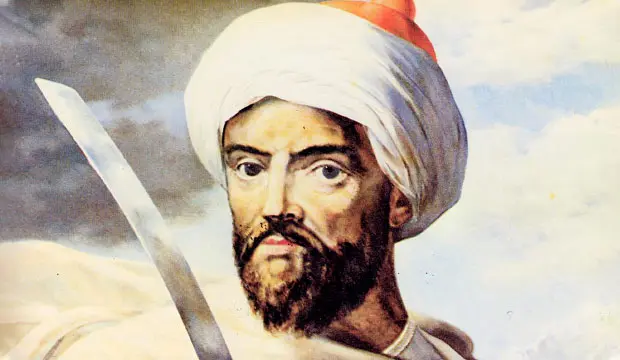
Moulay Ismail
You can’t really get a sense of Meknes without talking about Moulay Ismail, and vice versa. A lot has been written about him, and historians don’t always agree. But everyone pretty much sees him as meticulous, determined, forward-thinking, and suspicious. These traits helped him set up a centralized government, create an army to control Moroccan territory and fend off foreign invasions, and establish a tax system to fund his military campaigns and construction projects.
Our actions and choices define us the most. It’s believed Moulay Ismail had a harem of 500 women, which might make it seem like he had an insatiable desire for love (maybe he just wanted to build a legend around himself). But actually, the main goal was to avoid distractions for his massive army by bringing all the beautiful women of Meknes into his harem and enforcing a law that doomed any man who made a move on one of his companions.
What to Do in meknes
Meknes is brimming with monuments that really show off Moulay Ismail’s character. We’ll check out the iconic spots in Meknes, diving into its history and the mind behind it all.
Because Moulay Ismail did so much remodeling, the historic center is much bigger than in other Moroccan cities, and the main attractions are more spread out. So, instead of walking through the whole medina, we’ll mix it up with some car rides in between.
When we take a taxi in Morocco, remember it’s a good idea to negotiate a price with the driver beforehand. Make sure to clearly outline the main points you want to visit and clarify the total time you’ll need the driver (about 2 hours). You shouldn’t pay more than 200 dirhams for the whole service
The City Walls
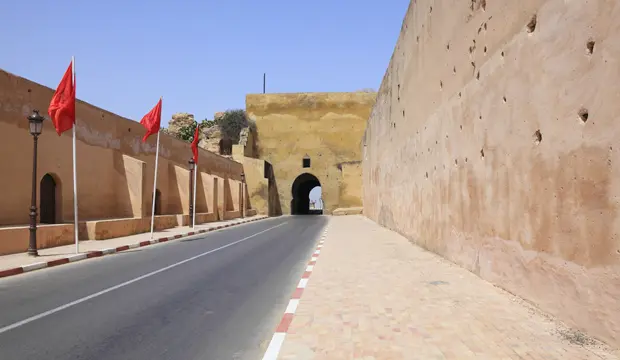
If there’s one thing Meknes is known for, it’s the 44 kilometers (about 27 miles) of walls surrounding it. These walls vary in thickness from around one and a half to three meters (about 5 to 10 feet) and in height from seven to fifteen meters (about 23 to 49 feet). Depending on how crucial the area is, the walls have different levels of depth. In some spots, like the royal palace or the resource warehouses, you might have to pass through three layers of walls.
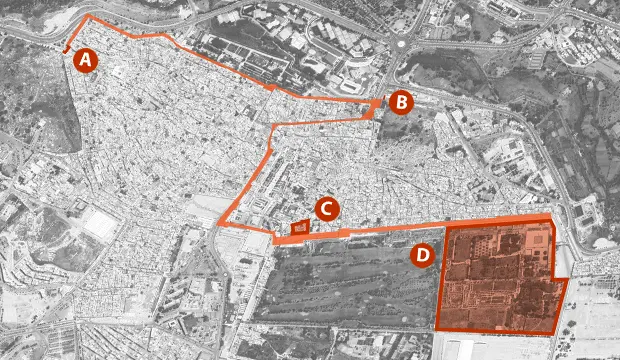
We’ll just tell the taxi driver we want to check out the walls, and they’ll drive us around to a representative part of them, which is usually about 6 kilometers (around 3.7 miles) long, passing several fortifications and gates. If you’re going on your own, you can use the GPS to plan a route that starts at Bab Berdaine, then goes to Bab Bou Ameir, cuts through the historic city center while passing by the Mausoleum of Moulay Ismail, and ending at the Royal Palace (Dar El-Makhzen).
The most important part of the defensive system designed by Moulay Ismail is the avenue leading to the Royal Palace. It’s flanked by walls on both sides and has a gate at each end. If an invader managed to get through the three layers of walls, they’d find the final gate wide open, making it look like the Sultan and his court had decided to flee. But once the invader got halfway down the avenue, the gates would shut on both ends. By the time they realized they’d been tricked, it would be too late. That’s why this street became known as “Death Avenue”.
At the end of the avenue, you’ll find the Royal Palace. Unfortunately, like other Moroccan royal palaces, you can’t tour the inside, so you’ll only be able to admire its gates.
From there, we can ask a taxi to take us to the next spot. The following three places are all close to each other, so we won’t need a vehicle to get from one to the other.


Sahrij Swani
Today, the place known as the Agdal Pond has been turned into a garden and recreational area. Originally, it was a massive water storage system, measuring about 150 meters (490 feet) wide and 300 meters (985 feet) long with an average depth of 1.2 meters (4 feet).
This system reflected the Sultan’s fear of running out of this precious resource for the citizens, crops, or animals in case of drought or a prolonged siege. A more well-known reservoir pond is found in the Menara Gardens in Marrakech. However, Moulay Ismail, ever cautious and meticulous, made the Agdal Pond more than twice as big.
Next to the pond stands a monument commonly known as the royal stables, although its main function was to store grain, probably the second most necessary resource.
Today, it appears as an open structure about 180 meters (590 feet) by 100 meters (330 feet). It is divided into 22 rows of transverse arches and a series of longitudinal corridors for efficient logistics and smooth circulation within the granary.

Unfortunately, to appreciate the most ingenious aspect of the monument you need to use your imagination. There used to be a wooden cover where mules loaded with grain were led, pouring it through strategically placed holes. These openings also helped create the two necessary conditions for proper grain storage: a stable, cool temperature and good ventilation.
Unlike water, the supply of grain depended mainly on the production of the villages near the city of Meknes. As a novel approach, Moulay Ismail dictated that the amount of grain each village had to provide was not a percentage of its production but all the surplus after ensuring its own subsistence. This way, grain could be distributed to other more needy villages.
This policy caused resentment among the more productive villages, and combined with other similar novel ideas, according to legend, made Moulay fear his own people more than foreign powers.
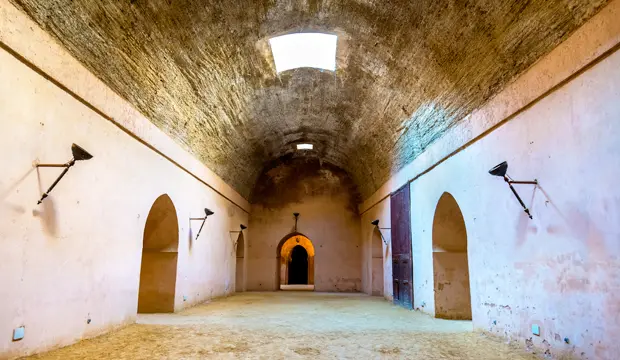
Dar al-Ma
Commonly known as “The House of the Ten Water Wheels,” it’s located at one end of the granary. It’s really well-preserved and even has replicas of old machinery.
Made up of a central chamber that connects to 15 vaulted chambers with corridors, each chamber has a well where water is drawn using a horse-powered water wheel. Once the water, carried in buckets, reached a higher level, it was poured into clay canals that connected both to the Agdal Reservoir and other supply points in the city.
The Sultan is well-known for having his soldiers perform a long list of routine, non-military tasks. Legend has it that he even had them in charge of water management here. Apparently, Moulay Ismail thought that a busy soldier was a soldier with no time to think, and therefore, no chance to plot a rebellion against the sultan.
The next stop, the Mausoleum of Moulay Ismail, will be where the taxi driver drops us off and we say goodbye to him, since we can easily walk the rest of the route.
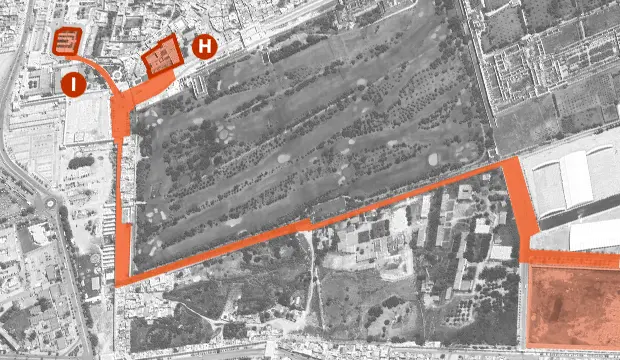
If we decide to use our own vehicle, it’s best to park at Lalla Aouda Plaza, just a 3-minute walk from the mausoleum. It’s a garden-like area where horse-drawn carriages usually park, and we have the option to park our car here under the care of the guard for 20 dirhams a day.
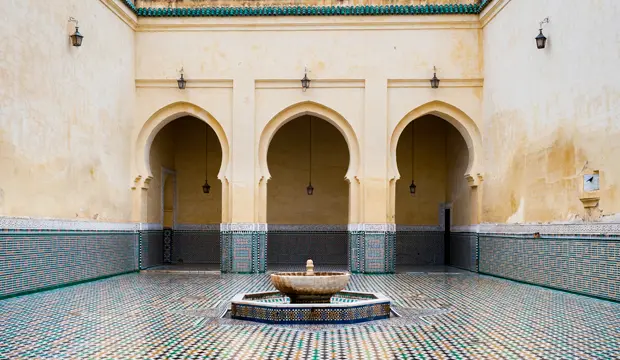
The Mausoleum of Moulay Ismail
Located inside the Dar el Kebira Palace, with a beautiful façade and an open area as its introduction, it’s usually a must-see stop even for those just passing through Meknes.
Built in 1703, the building underwent numerous additions and expansions, most of which were carried out under the rule of the sultan’s son, who served as a brief successor.
Entering through the south façade and after passing through the first ablution room, you reach several spacious rooms decorated with yellow stucco, geometric patterned tiles on the floors and walls, and greenish-toned roof tiles. After going through these rooms, you arrive at the area where the sultan is buried along with two of his sons. You’ll need to take off your shoes before entering.

The tomb features more intricate craftsmanship, with decorative work on the plaster walls and the cedar wood ceiling. It’s divided into two areas: the antechamber of the tombs, with a central ablution fountain, and the room where the remains of the sultan and his family rest, which is restricted by a railing that prevents non-Muslims from entering.
A subtle detail in the room is the pendulum clocks, a gift from Louis XIV of France to Moulay, with whom he had an excellent relationship. The Sultan was determined to stamp out foreign influences from Morocco. Nonetheless, Moulay was pragmatic and understood that sometimes having foreign allies was necessary, especially when they shared common enemies like Spain.
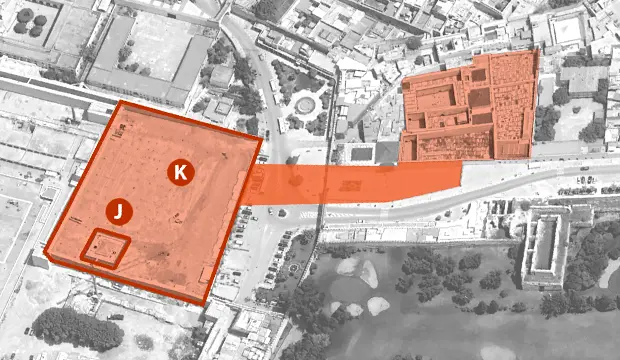

Ambassadors’ Pavilion and Cara Prison
Heading out to the right of the Mausoleum, there’s a large open area with openings, topped by a pavilion that Moulay Ismail used to welcome foreign ambassadors. This space was the face of power and majesty that the sultan presented to foreign dignitaries, showing himself to be a generous friend but a ruthless enemy.
This open area is actually the roof of a prison, with the roof hatches being the only way into the cells, making it impossible to get back to the surface once you’ve gone down. Inside the prison, we see only arches and thick walls. This austere space without divisions is a kilometer-long labyrinth without doors or bars, highlighting the harsh living conditions for prisoners.
At least, that’s what the legend says, possibly promoted by the sultan himself, who knew that ruling with an iron fist also meant building a fearsome image. In reality, it was only temporarily used as a prison once, and its true purpose was to function as a grain storage facility, similar to Heri es-Swani, where the holes in the roof made storage easier, allowing grain to be poured in directly from above.
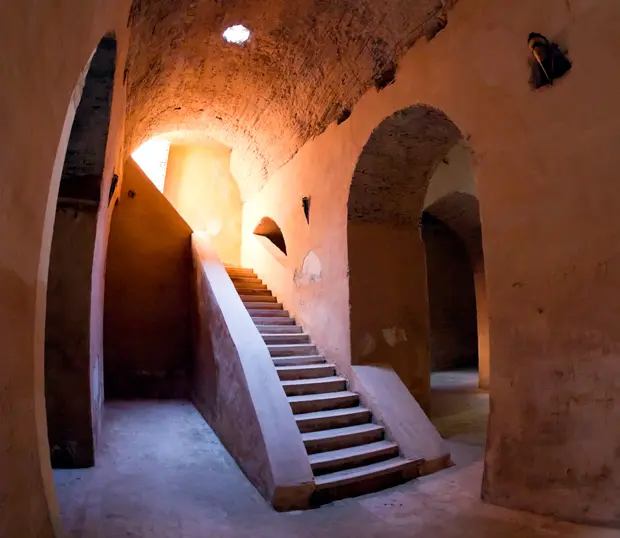
After exploring this area (which you can access from a staircase on the Ambassadors’ Pavilion), we’ll exit, turn left, and continue down the street, leaving Lalla Aouda Plaza on our right.
At one corner of the plaza, there’s a roundabout with two vehicle-only lanes that go through the two arches of the wall. To get through, we’ll use a smaller door located to the left of these arches (it can be confusing since you need to enter a shop inside the wall).
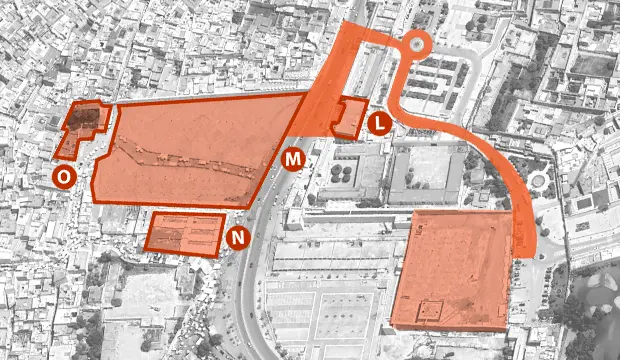
Bab Mansour and El Hedim Square
Crossing the wall to the left, we’ll see these two spots, probably the busiest and most touristy spots in the city, right across from each other.

Bab Mansour is the most iconic gate among all those lining the walls of Meknes. It also holds the title of the largest gate in Morocco and North Africa. Standing about 52 feet (16 meters) tall, it features a central section with a semi-circular arch opening 26 feet (8 meters) high, and two side towers with arches resting on marble columns.
Most of the façade is covered with tiles in shades of white, brown, blue, and green, arranged in floral patterns, while the rest is decorated with Arabic script.
It’s the most ornate of all the gates in the wall, as its function was more ceremonial than defensive. It served as the main entrance to the citadel where Moulay Ismail and his entourage lived, and it was designed to be a grandiose display to impress visitors.
This reminds us of the Roman triumphal arches in both how it works and how it looks. Which is likely where they took inspiration from, especially since its marble columns are actually Roman and probably repurposed from the old city of Volubilis. Plus, “Bab El Mansour” translates to “Gate of Triumph”.
El Hedim Square is popularly known as ‘the little Jemaa el Fna‘ because, just like the famous plaza in Marrakech, it doesn’t have any fancy decorations. What makes it interesting are the street stalls, henna artists, storytellers, and other street performers. Even though it’s smaller, its main advantage is that it’s way less touristy, so you can walk around without constantly getting hassled by peddlers.
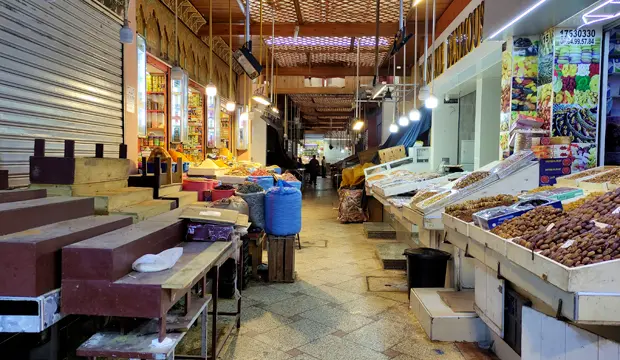
After checking out the plaza, try visiting the picturesque covered market on the southwest side. It’s totally geared towards locals and great for stocking up on a wide variety of sweets and pastries at low cost, or buying spices if you want to take the flavors of Morocco back home.
Another highlight of the plaza is the Dar Jamai Museum, located on the northwest side. This used to be the palace of a notable family in Meknes, and over time it served as a military hospital, a court, and now a museum where you can see ceramic pieces, textiles, and jewelry.
The museum might actually be more interesting for its building than its exhibits. It’s rich in plasterwork details on the walls and has carved wooden ceilings, but the real standout is the well-maintained, extensive garden that greets visitors. In any case, 30 dirhams well spent on a museum that radiates tranquility, elegance, and a great eye for detail.
For the next stop on our tour, we’ll take the street to the left as we exit the museum. At the end of the street, just a three-minute walk away, we’ll find it right in front of us.
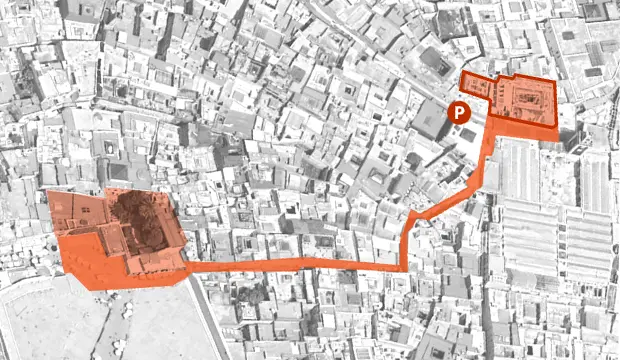
Bou Inania Madrasa
It’s easy to mix up the Bou Inania Madrasa with the more famous madrasa in Fez since they share the same name. Interestingly, the madrasa in Fez is named after the sultan who had it built, Abu Inan, while the one in Meknes was constructed 15 years earlier under the rule of his father. Later on, Abu Inan restored it, leaving his mark by renaming it and giving it a decoration style very similar to the one he had inaugurated in Fez.
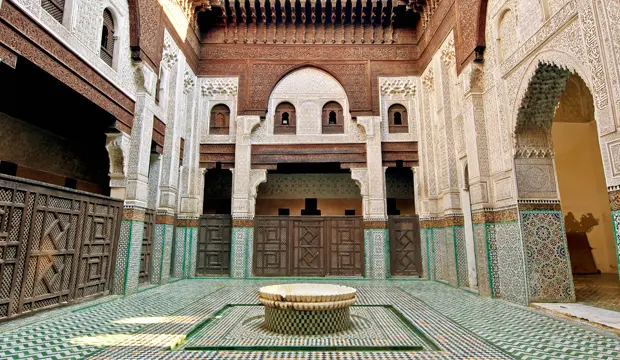
Once we go through the bronze entrance door and walk down a long hallway—which is common in madrasas to block out street noise—we’ll arrive at the ablution courtyard. If you’ve already visited the one in Fez, you’ll definitely have a sense of déjà vu because it decorated in a similar fashion: carved plaster on the walls (except for the first two meters, which are covered with tiles), carved wood on doors, windows, balconies, and the upper wall edges, and green-toned roof tiles. Despite the similarities, this visit is totally worth it because, unlike in Fez where only the courtyard is accessible, in Meknes you can explore the whole complex.
With the entrance behind us, to the right of the courtyard there’s a small mosque, while to the left, behind a wooden lattice, is the first row of student rooms and the staircase that leads to the other floors.
Spread out along a perimeter hallway, all the rooms are quite spartan, just big enough for a bed. They all open to the ablution courtyard through narrow windows, except for the room closest to the front, which also has a window facing the street. That room was for the madrasa’s dean, whose job was to keep an eye on things through that window and make sure no student was getting too caught up in street life.
If we continue up the stairs, we’ll reach the rooftop, where we’ll have the chance to see the craftsmanship on the rooftops and how all the parts of the madrasa fit together. From here, you also get a great view of the nearby mosque, which is the biggest in the city, and its minaret.

Finally, in a space adjacent to the madrasa, there’s the bath area. Its main room has a warm water fountain (the water was heated in a nearby room and funneled to the central fountain) and individual booths around it. Although the room is simple, the upper windows let in fresh air and green-tinged light reflecting off the roof tiles, creating a magical atmosphere. Interestingly, the madrasa in Fez doesn’t have a bath area, so students there had to organize regular outings to clean up.
The Medina of Meknes
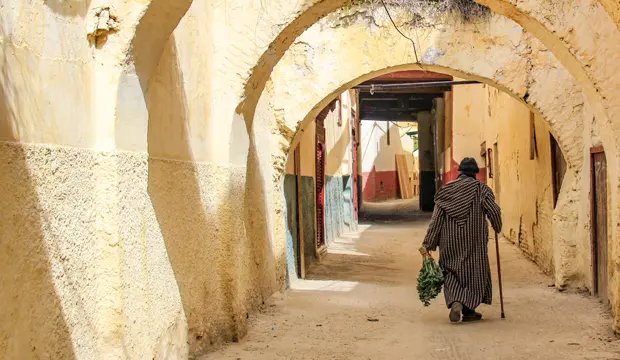
After visiting all the important monuments in the city, we can spend the rest of the day wandering around its medina with no particular agenda.

The most picturesque area is around the Grand Mosque, right across from the madrasa we just visited, because that’s where the city’s souks are.
The most visually striking ones are Bab Jdid (musical instruments), Bezzazine (basketry), Nejjarine (carpentry), Sekkanike (tinsmiths), and El Herir (silk fabrics).
Wandering through a Moroccan medina is always an invitation to lose yourself in the labyrinth and discover an array of beautiful scenes. This is especially true in a city like Meknes, which doesn’t attract many tourists. You won’t be bothered by tricky peddlers. You can enjoy a peaceful stroll and the chance to witness the daily life of the locals.
Meknes, a forgotten gem among Morocco’s imperial cities, retains the mark of its benefactor, Moulay Ismail. Its rich history and monumental grandeur remain almost perfectly intact, as if time has decided to grant it a respite to preserve its splendor.
Today, still far from mass tourism, it remains an open-air museum, a testament to a glorious past waiting to be rediscovered.
Coordinates: 30°55′N 6°55′W (see location)
Population: 520,000 aprox.
Founded: 10th century. Transformed and became an imperial city in 1672
Climate: Average high and low temperatures by season: Spring (8-26ºC; 46-79ºF), Summer (15-36ºC; 59-97ºF), Autumn (9-33ºC; 48-91ºF), Winter (4-17ºC; 39-63ºF). Chance of precipitation mostly only in winter.
Where to eat: SIt’s typical to have lunch at one of the panoramic restaurants on the plaza, but they’re very touristy and often low quality. A better alternative is Aisha Restaurant (see location), near the plaza, which offers a wide variety of homemade food at affordable prices.
Meknes is located near Fez. If you want to know more about this city, visit our Fez guide.